Documents I Can Upload in Adobe Indesign
PubCoder features an InDesign import functionality that allows you to import layouts and assets from 1 or more Adobe InDesign documents into a PubCoder Project that is perfectly editable after the import, complete with layers, avails and existent text.
How information technology works
PubCoder'southward InDesign import works in a totally automated mode and y'all tin skip this paragraph safely, but if you lot're curious most what's happening under the hood, here information technology is.
At first, PubCoder will connect to Adobe InDesign, and execute scripts to open up the document and browse it to copy the diverse informations nigh objects and layers positions, and import all linked resources in the InDesign file as assets in PubCoder, when possible. Some specific images may be rendered for better performance, east.g. geometric forms that do not have a respective object in PubCoder.
Text is imported in a second stage: PubCoder will ask InDesign to consign the certificate in EPUB 3 fixed layout format, and so PubCoder will scan this document to import text and CSS styles for text formatting, that will exist appended to the project'southward CSS code.
At the end of the procedure, yous volition accept a completely editable PubCoder project, with one (or more) object(s) for each object in the InDesign document.
Create a new projection starting from InDesign layout(s)
Start by creating a new project (File → New Projection) and choose to Start from InDesign file . Y'all volition exist asked to select a few files to import: you can add together them dropping them on the files expanse or clicking the + button, then you lot can conform their import order dragging them.
PubCoder volition then launch InDesign and check that everything is OK with the documents, warning if it finds:
- Links to missing resources: your InDesign document is linking to resources (east.g. prototype files) that cannot be found on deejay
- Missing Font files: your InDesign document is using some font that is non installed on your computer nor it can be found in the bundle
- Incompatible Fonts: your InDesign documents uses fonts that are not compatible with PubCoder, you'll learn more near this after
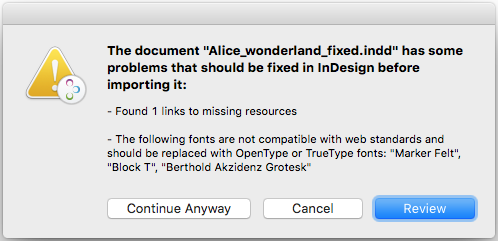
This warning will not cake PubCoder from importing your InDesign certificate, but volition touch the quality of the import: missing images will not be present or will be imported in low quality, text volition non apply the right fonts and so on. Our advice is to click Review to open the document in InDesign and fix those issues here, then attempt to import the file again in PubCoder.
Next, PubCoder will present the import settings panel:
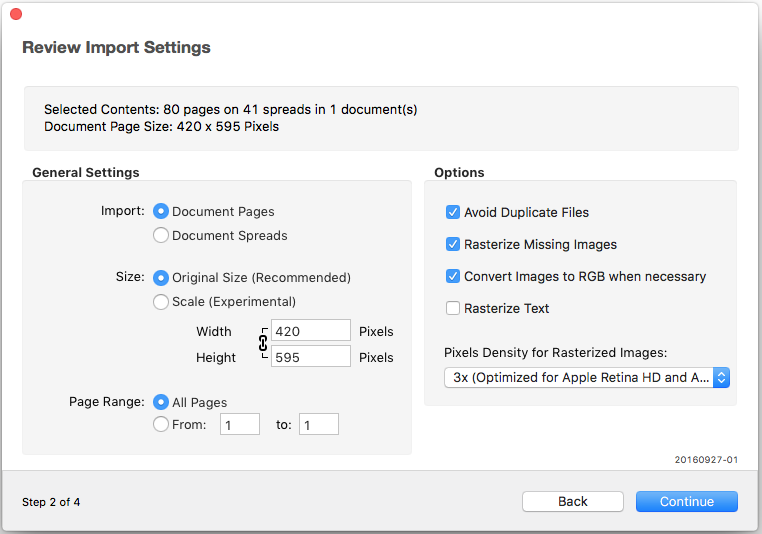
You may be fine with the default settings and but need to click Next to actually start the import process, which will go on without further intervention by the user. The process tin be stopped at any stage and will eventually brandish a report of issues encountered.
Detailed descriptions for each settings follows.
Import Document Pages or Spreads
In the commencement case, PubCoder will create a new project page for each page in the InDesign document, in the 2nd case PubCoder will create a new projection page for each spread in the InDesign document: this is useful if you want to create a landscape eBook starting from an InDesign document with contents in between facing pages
Size
Allows to control the size of the imported content. Our recommendation is to stick with the original size of the certificate: this guarantees the best fidelity to the original layout and also the content will exist scaled properly by the reader app or device without losing any quality, since PubCoder imports real text and real avails rendered upwards at 3x their original size. An experimental scaling feature is likewise provided, merely you may obtain meliorate results by scaling the document in InDesign before importing the file.
Page Range
Choose if importing the whole document or a range of pages only
Avoid Duplicate Files
If the import process will produce a file that is identical to another file already present in the project (eastward.g. content present on some other page or fifty-fifty in another imported document), it will use the already existing file instead of importing another copy. This is enabled by default.
Rasterize Missing Images
If the document links to an epitome file that cannot be plant, this option allows to import a low-quality rendered version of the paradigm anyhow. This is enabled past default.
Convert Images to RGB when necessary.
Converts CMYK images to RGB and imports only RGB documents. This is slow and should be enabled only if the original images should not display correctly in PubCoder.
Rasterize Text
This option allows to import a rendered paradigm for each text-box, instead of the real text, should you need it.
Pixels Density for Rasterized Images
PubCoder imports the real image files linked to your documents, but also produces rendered images for some elements that are not directly supported in PubCoder, for example some geometric forms and some vector images such as EPS, PDF or Adobe Illustrator files: this setting allows you to increase the original resolution in order to support high-resolution displays and to allow scaling up without pixelating images. The default setting is 3x.
Importing in an existing project
PubCoder also allows to import InDesign avails and layouts into an existing project (File → Import Assets from Adobe InDesign). The process is the same but with two differences, the first is that PubCoder will effort to scale the content to lucifer your project size, the second is that pages but besides CSS code will be appended to your project.
Our advice is to always start creating a new projection directly from InDesign files like we described in the previous paragraph. If yous need to "add" other files later on, please exist sure to proper name those files differently to avert CSS conflicts.
Editing Text
To guarantee that what y'all'll come across in PubCoder is the nearest as possible to what you come across InDesign, PubCoder encapsulates CSS data in your project to obtain fixed positioning of each discussion (this data is actually derived from InDesign's own EPUB Fixed Layout export of the document). Equally already said, this volition give the best possible match to what you see in InDesign, but on the other side it will make text editing cumbersome, because the text won't "wrap" automatically when modified.
This may not be an issue at all if yous don't need to modify the text. Should you demand to modify text object imported from InDesign, double-clicking the object will result in PubCoder request the following:
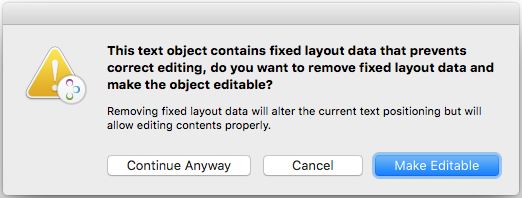
Clicking Make Editable will remove stock-still layout information, thus making your text easily editable only loosing the original text positioning and wrapping. If y'all merely need to fix a typo, you may endeavour to employ the Continue Anyhow option, that will allow you to edit the text as-is, preserving the fixed positioning of each word.
Fonts compatibility
Since PubCoder uses web technologies to gather your contents into all supported formats, information technology needs to work with font that are compatible with web standars. Specifically, PubCoder supports TrueType (.tt or .ttf extension) or OpenType (.otf extension). To use the same fonts used in your InDesign certificate, you have to brand sure that they are in TrueType or OpenType formats. InDesign documents ofttimes apply PostScript Type i and other formats that simply won't work in EPUB or other spider web-based formats (the same InDesign is unable to use them in its EPUB export) and demand to exist converted and replaced in the original InDesign certificate.
Before importing an InDesign document, PubCoder will bank check fonts used in the document and eventually warn if unsupported fonts are found. In this case, our advice is to export a package of your InDesign document (menu File → Package) if it'due south not already packaged (otherwise just save the document equally a copy). This volition consign your document together with two folders: Links and Document Fonts and allows you to easily identify fonts to be replaced in the Document Fonts directory (only check file extensions).
Yous can apply software like TransType or FontXChange (both available for Mac and Windows) to convert incompatible fonts to TrueType or OpenType format, saving them in a new binder, say "Document Fonts (Converted)".
One time fonts have been converted to TTF or OTF, motion incompatible fonts in some other folder, perhaps named "Document Fonts (Disabled)" and move the individual converted font files in the Document Fonts folder.
Yous can now re-open your packaged document in InDesign, and information technology should complain virtually missing fonts (unless the fonts you moved to "Document Fonts (Disabled)" are too installed on the system). Now yous will demand to replace in the InDesign document the fonts yous merely replaced equally files in the Finder. Choose menu Type → Detect Font and a window like this should open:
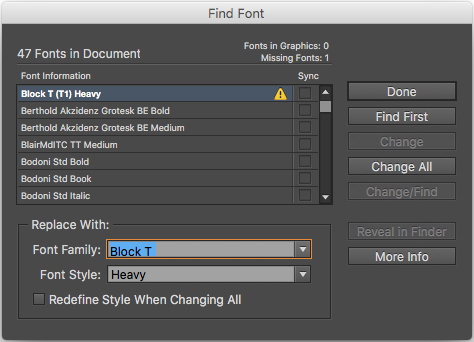
For each font replaced, you take to select it, select the respective font family and style of the font converted to TrueType or OpenType and click "Change All". Note that the original font used may be labelled with a suffix (like "T1" for "Type 1") and that the fonts contained in the "Document Fonts" folder should appear at the top of the list.
When you lot're done, save and close the document in InDesign: y'all tin now import the fixed version of the certificate safely in PubCoder (remember to select the new, fixed InDesign file in PubCoder since the previous may still be selected).
For more than informations about fonts in PubCoder, please cheque the Fonts Troubleshooting section.
Source: https://docs.pubcoder.com/pubcoder_import_indesign.html
0 Response to "Documents I Can Upload in Adobe Indesign"
Post a Comment