What Is Evs Board for Uploading Slides
The send sector accounts for xviii% of total energy consumption in India. This translates to an estimated 94 meg tonnes of oil equivalent (MTOE) energy. If India were to follow the current trends of energy consumption, it would crave an estimated 200 MTOE of energy supply annually, by the year 2030 to meet the need of this sector. At the moment, this demand is being met mostly through imported crude oil, which therefore makes this sector vulnerable to the volatile International crude oil prices. Moreover, the sector also contributes an estimated 142 Million Tonnes of CO2 emissions annually, out of which 123 million tonnes is contributed by the road transport segment lone.
Keeping in view the climate change commitments made past Regime of Republic of india during the COP21 Summit held at Paris to reduce emission intensity past 33- 35% by 2030 from 2005 levels, it is pertinent to introduce culling means in the transport sector which tin exist coupled with India's rapid economic growth, rising urbanization, travel demand and country'due south free energy security. Electric mobility presents a viable culling in addressing these challenges, when packaged with innovative pricing solutions, appropriate technology and support infrastructure and thus, has been on the radar of Regime of India.
Electric mobility will also contribute to balancing energy demand, free energy storage and environmental sustainability. Electric vehicles could help diversify the energy needed to motility people and goods thanks to their reliance on the wide mix of primary free energy sources used in power generation, greatly improving free energy security. Thank you to their storage chapters, they could help support the uptake of clean electricity, enabling greater employ of variable renewable in electricity production. If coupled with the decarburization of the power sector, electrical vehicles would too provide major contributions to go along the globe on track to meet its shared climate goals.
Electrical mobility comes with nada or ultra-low tailpipe emissions of local air pollutants and much lower racket, and, by being i of the most innovative clusters for the automotive sector, tin can provide a major heave to the economical and industrial competitiveness, attracting investments, especially in countries.
The Electric Vehicle industry in India is far behind, with less than 1% of the total vehicle sales. Currently, Indian roads are dominated by conventional vehicles and have approximately 0.4 million electrical 2-wheelers and a few thousand electric cars only. The Indian EV industry has been on the back seat due to diverse challenges.
The regime of India have undertaken multiple initiatives to promote manufacturing and adoption of electric vehicles in India. With support of the authorities, electric vehicles have started penetrating in the Indian market. Nevertheless, availability of acceptable Charging Infrastructure is 1 of the cardinal requirements for accelerated adoption of electrical vehicles in Bharat.
Availability of adequate Charging Infrastructure is one of the key requirements for accelerating the adoption of electric vehicles in India. In this regard, Ministry of Power has issued "Charging Infrastructure for Electrical Vehicles – Guidelines and Standards" mentioning the roles and responsibilities of various stakeholders at Fundamental & State level, for expediting the evolution of public EV charging infrastructure across the country. Ministry of Ability has designated Agency of Energy Efficiency (BEE) as the Primal Nodal Bureau (CNA) for the National-level rollout of charging infrastructure in the country.
Almost Electrical Vehicle
Electric Vehicles (EVs) are run by electric motors which are powered past energy stored in batteries. EVs have an electric motor instead of an Internal Combustion Engine (ICE). Equally an EV runs on electricity, the vehicle emits no exhaust from a tailpipe i.eastward. it has zippo tail piping emission and does not contain components, such as a fuel pump, fuel line, or fuel tank.
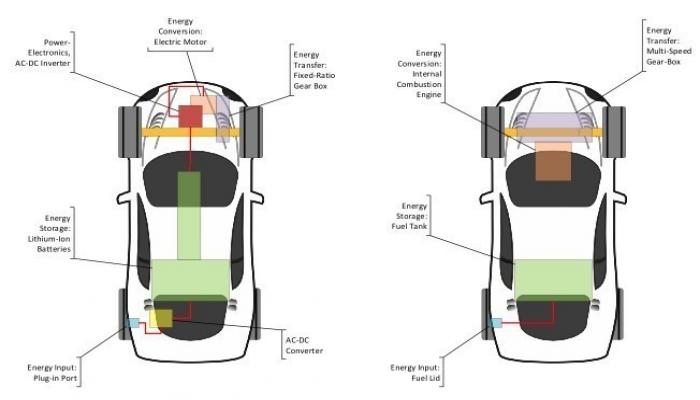
Effigy 1: Components of Internal Combustion Engine Vehicle and Electric Vehicle
Benefits of choosing an Electric Vehicle (EV) over Internal Combustion Engine (ICE) Vehicle
Other Benefits:
-
Economical:
-
EVs have fewer moving parts as compared to ICE, thus EVs need less maintenance.
-
Higher efficiency, lower fuel cost and lower operational cost makes EVs economical than ICE vehicles.
-
-
Improved Air quality:
-
EVs have no tailpipe emission equally compared to ICE vehicles. Adopting EVs will help in reducing local air pollution.
-
Shifting to EVs will reduce Greenhouse Gas (GHG) emissions that gets emitted from running an Water ice vehicle.
-
-
Convenience:
-
EVs accept no gears and are much easier to bulldoze than Ice vehicles
-
The lack of a combustion and mechanical drivetrain makes EVs much quieter
-
Comfortably charge at dwelling
-
Upfront incentives from Authorities to EV owners
-
Incentive for scrapping ICE vehicles
-
EV owners can claim income tax deduction upwardly to Rs 150,000 under Section 80EEB
-
Reduced dependence of imported fossil fuel for the Country
-
Electric Vehicle Myth Busters
-
Send sector is non a major contributor to emissions
Transport sector accounts for 23% of global GHG emissions. A study conducted in New Delhi on vehicular emissions shows that transport sector contributes significantly to particulate matter and NOx emission causing respiratory ailments. Through adoption of EV, the vehicular emission can exist brought down significantly, hence enabling a healthier lifestyle.
-
EVs take too long to charge
Time of EV charging depends upon the type of charger adopted for charging. Currently available EVs across vehicle segments (2-wheeler, three-wheeler, four-wheeler) tin be charged from 0%-80% in around, 1 – 5 hours from Slow/Moderate chargers while using Fast chargers, EVs tin be charged in less than ane hour. Fast chargers are mainly used to charge electric 4-wheeler. Rate of charging is also dependent upon Jail cell Chemical science.
-
EVs are costly
Although EVs might have a higher upfront cost, the Full Cost of Buying (TCO) of EVs is quite depression, every bit charging, maintenance and operational costs is much lower than that of ICE vehicles. Moreover, the upfront subsidy provided by the central/land government further reduces the overall cost of EVs. Calculator to gauge tentative TCO is bachelor at below link:
-
EVs take Low Range
With introduction of high-density batteries in EVs, the storage capacity of batteries has increased thus improving the range of EVs. The average range of electric 2-wheelers currently available in the market is around 84 km per accuse which is sufficient for twenty-four hour period to day travel within a city and the average range of electrical cars bachelor in the market is between 150-200 km per charge. Further, upcoming models across vehicle segments have higher battery capacity and range.
-
EVs are not condom
EVs are safety every bit all EVs undergo rigorous rubber testing. The challenge of burn and explosion take chances in batteries is being addressed by most EV manufacturers with their efficient and intelligent Bombardment Management Systems (BMS) which perform job of cooling, heating, insulation & ventilation of Batteries, etc. The certification agencies, Automotive Research Association of Bharat (ARAI), International Centre for Automotive Engineering (ICAT) does rigorous testing for overcharge, short excursion and vibration. Thus, it is safe to drive an EV.
-
EVs have Low Speed
EVs are equipped with high-speed powertrains therefore EVs offering better acceleration and speed. As far as speed is concerned, EVs available in the Indian marketplace have top speeds depending upon the model selected / opted. EVs have a loftier starting torque every bit compared to ICE counterparts and accelerate faster.
-
EV batteries need to be replaced ofttimes
EV batteries today have warranty of iii to 8 years, across electric two-wheeler, 3-wheeler and 4-wheeler categories. The actual bombardment warranty may vary depending upon the vehicle usage.
-
There are not plenty EV charging stations
Government is pushing deployment of EV charging stations by providing capital subsidy through Faster Adoption and Manufacturing of (Hybrid &) Electrical Vehicles in India, (FAME) India Scheme Phase II and land level initiatives. Further, government has delicenced the activity of setting up EV charging stations to increase private sector investments and facilitate market adoption. Thus, in the coming years there will be sufficient availability of Public Charging Stations (PCS) for EV owners.
Frequently Asked Questions on Electric Vehicles
-
What is an EV?
EVs are electric vehicles with rechargeable batteries which can be charged by electricity from an external source.
-
What is an EV Supply Equipment (EVSE)?
EVSE includes the electric equipment external to the EV that provides a connection for an EV to a power source for charging and is equipped with advanced features like smart metering, cellular capability and network connectivity.
-
What are unlike specifications of Charging Infrastructure?
Specifications of charging infrastructure as per guidelines issued by Ministry of Power:
Table one: Specification of Charging Infrastructure
Charger Type
Charger Connectors*
Rated Output Voltage
No. of Connector Guns (CG)
Charging EV Blazon
Fast
Combined Charging Arrangement (CCS) (min. 50 kW)
200 – 750 or higher
1 CG
4-wheeler
Accuse de Motion (CHAdeMO) (min. l kW)
200 – 500 or higher
1 CG
4-wheeler
Type – 2 Air-conditioning (min. 22 kW)
380 – 415
1 CG
4-wheeler, three-wheeler, 2-wheeler
Deadening / Moderate
Bharat DC-001 (xv kW)
48
1 CG
4-wheeler, three-wheeler, 2-wheeler
Bharat DC-001 (xv kW)
72 or college
ane CG
4-wheeler
Bharat AC – 001 (10 kW)
230
3 CG of 3.iii kW each
iv-wheeler, 3-wheeler, ii-wheeler
*In addition, any other Fast / Moderate / Dull charger as approved by Department of Science & Technology (DST) / Bureau of Indian Standards (BIS) standards whenever notified.
Note: Type – 2 Air-conditioning (min. 22 kW) is capable of charging electric 2-wheeler / iii-wheeler with the provision of an adaptor
-
What are the types of EV?
EVs include Plug in Hybrid Electric Vehicles (PHEVs) and Hybrid Electric Vehicles (HEVs) in improver to pure battery electric vehicles (BEVs). PHEVs utilize both petrol / diesel and electricity. These vehicles have two power systems, an internal combustion engine and a battery. The battery can be recharged by plugging the vehicle into an external source. HEVs combine conventional Water ice systems with electric propulsion systems. They utilise regenerative braking to catechumen energy that is normally wasted during braking into electricity. This electricity is stored in a battery.
Figure 3: Electric Vehicle Figure 2: Plug-in Hybrid Electric Vehicle
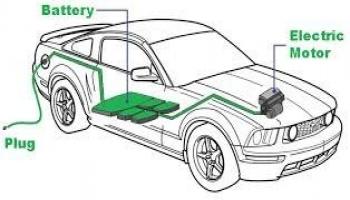
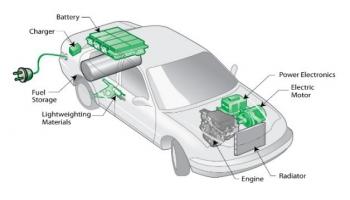
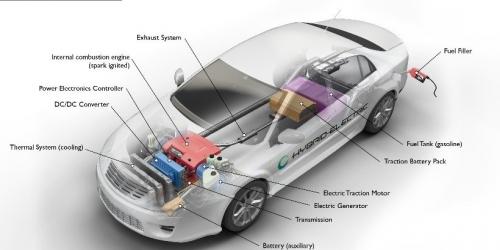
Figure 4: Hybrid Electric Vehicle
-
Are EVs less polluting than Ice vehicles?
Conventional petrol / diesel vehicles and Compressed Natural Gas (CNG) vehicles contribute to particulate emissions which is a major reason for vehicular based emission. Battery operated vehicles have zero tailpipe and noise emissions.
-
How long does it accept to charge an EV?
An electrical car having around xxx kWh battery pack takes less than 1 hr to exist charged up to 80% of its battery capacity using Fast Charger (l kW), while to attain like percentage of charging, Slow / Moderate charger (xv A plug) takes effectually 8 hours.
-
How much does it price to charge an EV?
The cost for a single charge (abode charge) shall vary State to State as per notified State EV tariff and bombardment chapters of the vehicle. This tin be estimated by the formula = Bombardment capacity (in kWh) X EV charging tariff (in INR/ kWh) (Refer Land EV tariffs)
-
Is information technology costly to operate an EV over a period equally compared to an ICE vehicle?
An EV has a higher upfront cost of procurement every bit compared to its Water ice counterpart. However, the cost of charging, maintaining and operating an EV is lower than the Ice vehicle which in turns reduces the TCO of an EV. For example, Tata Tigor and Tata Tigor EV has been considered for calculation. Tata Tigor has a claimed range of approximately 20 kms per litre. Bold, a running of 100 kms, information technology would consume effectually 5 litres of petrol. Bold the toll of petrol of INR 86.95 per litre, as of 08 Feb 2021. Hence, the toll of travelling 100 kms is INR 434.75. Tata Tigor EV, with a total battery capacity of 21.5 kWh, the total toll of charging the EV would exist 21.v kWh x INR 4.v per kWh (Assuming EV dwelling charging tariff for Delhi), i.due east. around INR 96.75. Hence information technology is economical to operate an EV than ICE vehicle.
-
Where can I charge my EV?
EV can be charged either at PCS or at your home. Government is deploying PCS at a faster footstep then that EV owners tin can accuse their vehicles comfortably. Apart from this, many Oil Marketing Companies (OMCs) are setting up EV charging stations at their oil retail outlets / fuel pumps such that EV owners can hands locate charging stations.
-
How can I find an EV charging station near me?
A lot of technology providers (i.e. Network Service Providers) are developing mobile based applications which shall provide information well-nigh nearest public charging indicate location, expected waiting time and cost of charging.
-
Are EVs prophylactic?
All EV batteries get through rigorous testing procedures at National Accreditation Lath for Testing and Scale Laboratories (NABL) certified labs. Certification agencies in India like ARAI, ICAT certify EV and Chargers. Thus, information technology is safe to drive an EV.
-
What are the benefits from the government for purchase of EVs?
Cardinal as well equally State governments have been promoting adoption of EVs by providing fiscal equally well as non-fiscal incentives. Some of the incentives being provided on purchase of EVs are: • Upfront capital subsidy nether FAME India Scheme Stage Two • Goods & Services Tax (GST) on EVs has been reduced from 12% to 5%, • Income tax deduction tin be claimed on the interest paid on loans taken for buy of EVs.
Central regime incentives to Electric Vehicle owners
-
Faster Adoption and Manufacturing of (Hybrid &) Electric Vehicles in India, (FAME India) Scheme Phase 2 - https://fame2.heavyindustry.gov.in/WriteReadData/userfiles/8th%20March%202019%20Gazette%20Notification%20FAME-II.pdf
National / State Electric Vehicle Policies and Regulations
Regulations issued by Ministry of Power, Government of India
-
Charging Infrastructure for Electric Vehicles - Revised Guidelines and Standards October 2019 - https://powermin.gov.in/sites/default/files/uploads/Revised_MoP_Guidelines_01_10_2019.pdf
-
Subpoena in the revised Guidelines and Standards for Charging Infrastructure for Electric Vehicles June 2020 - https://powermin.gov.in/sites/default/files/uploads/Amendment_in_Revised_Guidelines.pdf
-
Regulation regarding delicensing the auction of electricity at charging stations April 2018 - https://powermin.gov.in/sites/default/files/uploads/Clarification_EV.pdf
-
Central Electricity Authority (measures relating to the Safety and Electrical Supply) Regulations June 2019 - https://powermin.gov.in/sites/default/files/uploads/CEA_Safety_Standards%20_28_06_2019.pdf
Regulations issued by other Ministries
-
Guidelines issued by Ministry building of Housing and Urban Affairs (MoHUA), 2016 - http://mohua.gov.in/upload/whatsnew/5c6e472b20d0aGuidelines%20(EVCI).pdf
State EV policies:
| Southward. No. | State | State EV Policy |
| | Andhra Pradesh | https://world wide web.acma.in/uploads/md/AP%20Policy_final.pdf |
| | Karnataka | https://kum.karnataka.gov.in/KUM/PDFS/KEVESPPolicyInsidepagesfinal.pdf |
| | Kerala | https://anert.gov.in/sites/default/files/inline-files/go20190310_Trans-24-Ms_e_vehicle_policy_.pdf |
| | Delhi | https://transport.delhi.gov.in/sites/default/files/All-PDF/Delhi_Electric_Vehicles_Policy_2020.pdf |
| | Maharashtra | https://www.msins.in/guidelines_docs/english/EV_Policy.pdf |
| | Uttarakhand | https://www.siidcul.com/upload/industrialPolicy/electric1576487934.pdf |
| | Madhya Pradesh | http://mpurban.gov.in/Uploaded%20Document/guidelines/1-MPEVP2019.pdf |
| | Tamil Nadu | https://cms.tn.gov.in/sites/default/files/go/ind_e_176_2019.pdf |
| | Uttar Pradesh | http://udyogbandhu.com/DataFiles/CMS/file/Electrical%20%20vehicle%20policy_english_Aug7_2019.pdf |
| | Telangana | https://tsredco.telangana.gov.in/Updates_2020/Telangana_EVES_policy_2020_30.pdf |
| | Bihar | http://www.investbihar.co.in/Download/Draft_for_e_vechile.pdf |
| | Gujarat | https://wri-republic of india.org/sites/default/files/3.D1_S1_Gujarat%20State%20EV%20Draft%20Policy_Akash%20Davda.pdf |
| | Punjab | http://punjabtransport.org/Punjab%20EV%20Policy_Final%20Draft%2015112019_Upload.pdf |
| | Haryana | https://haryanatransport.gov.in/sites/default/files/Electric%20Vehicle%20Policy_2.pdf |
State Electric Vehicle Tariffs
| Due south. No. | State | Tariff Club approved past State Electricity Regulatory Commission (SERC)* |
| | Uttar Pradesh | https://www.upenergy.in/site/writereaddata/UploadNews/corrigendum/pdf/C_201903141428135216.pdf |
| | Punjab | http://pserc.gov.in/pages/7.%20Chapter%207%20PSPCL%20Tariff%20Order%20FY%202020-21.pdf |
| | Gujarat | https://www.gercin.org/wp-content/uploads/document/549522c6-8a24-4049-8c17-a99a01b6b351.pdf |
| | Chandigarh | http://chdengineering.gov.in/pages/Tariff-Gild-FY-2020-21.pdf |
| | Telangana | http://world wide web.tsnpdcl.in/Amendment%20tariff%20order |
| | Karnataka | https://karunadu.karnataka.gov.in/Tariff%20Order%202019/BESCOM/8-BESCOM%20-%20CHAPTER%xx-%20%206.pdf |
| | Andhra Pradesh | http://aperc.gov.in/admin/upload/RSTFY2021.pdf |
| | Kerala | https://erckerala.org/orders/ARR%20ERC%20-%202018-19%20to%202021-22.pdf |
| | Delhi | http://www.derc.gov.in/sites/default/files/Tariff%20Schedule%202020-21.pdf |
| | Maharashtra | https://www.mahadiscom.in/consumer/wp-content/uploads/2020/04/Commercial_Circular_for_MYT_Order-three.pdf |
| | Uttarakhand | http://www.uerc.gov.in/ordersPetitions/orders/Tariff/Tariff%20Order/2020-21/UPCL/Comprisal%20Order.pdf |
| | Madhya Pradesh | http://www.mperc.in/Retail%20Supply%20Tariff%20Order%20for%20FY%202020-21.pdf |
| | Jharkhand | https://jbvnl.co.in/upload/0IOKV9.jbvnl%20tariff%20order%202020-2021.pdf |
| | Haryana | https://uhbvn.org.in/staticContent/documents/Tariff.pdf |
| | Chhattisgarh | http://www.cserc.gov.in/upload/upload_news/04-07-2020_15938599571.pdf |
| | Rajasthan | https://rerc.rajasthan.gov.in/rerc-user-files/function-orders |
* The above links of Tariff Orders is updated every bit on 11thursday Feb 2021.
Tentative Ownership Cost Calculator (EV V/S ICE Vehicles) for Home Charging
State Nodal Agencies nether the provision of "Charging Infrastructure for Electric Vehicles-Guidelines and Standards" issued by Ministry building of Power
1. Charging infrastructure for Electric Vehicles(EVs)-Revised Guidelines and Standards issued on 01.10.2019
2. Charging Infrastructure for Electric Vehicles (EV) – the revised consolidated Guidelines & Standards issued on 14th January 2022
Source: https://beeindia.gov.in/content/e-mobility
0 Response to "What Is Evs Board for Uploading Slides"
Post a Comment